Hygge is a word that’s hard to translate and you might be forgiven for thinking it’s some new hippy craze, but it’s actually been around for a while. Its appeal is spreading across the world as more countries embrace the practice.
So, what does it mean and how do you incorporate it into your life? There are lots of ways to bring this process to your being and your surroundings. The infographic below will give you all the information you need to begin your own hygge style journey to a more contented you.
It’s not news that having an animal friend has its benefits since teaches you to be responsible for someone who is always happy to see you, who keeps you company without prejudice and even can help you being more outgoing and improves your mood. Through Happify’s infographic you’ll learn that, besides all the above, your pet affects your emotional wellbeing. Check it out below to learn how and why they make us happier:
What is exercise fact vs myth? The craze surrounding exercise, weight, health, and fitness in America is a curious thing. Huge government subsidies make grains (like sugary cereals and nutritionally-empty white bread) artificially inexpensive. Fast food like McDonalds and Wendy’s is some of the cheapest commercially available food in the world.
Advertising for bad food, beer, and liquor is everywhere. However, who is always hocking this terrible food and booze? Some of the fittest, most attractive people around. People used in advertisements, if not outright fit and athletic, are at least trim and not overweight or obese.
The food model traditionally adopted in the Mediterranean countries (particularly in Italy, Spain, Portugal, Greece and southern France) is characterized by its nutritional balance and is in fact recognized by many food scientists as one of the absolute best for what concerns the physical well-being and prevention of chronic diseases, especially cardiovascular diseases.
This is the food model that has been considered for the construction of the nutritional part of the Double Pyramid, introduced in 2010.
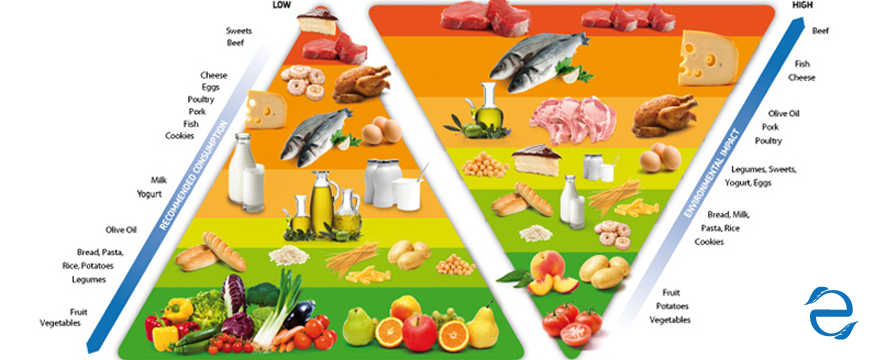
Maintaining the nutritional part of the Double Pyramid and replacing the environmental one with the revision that resulted from the elaborations of this new edition, the following is the updated BCFN Double Pyramid.
A model for people’s wellbeing and protecting the environment
What is the environmental impact resulting from production, distribution, and consumption of food? To answer these questions, the Barilla Center for Food & Nutrition created the Double Food – Environmental Pyramid model, a tool that compares the nutritional aspect of foods with their environmental impact.
A unique food model created to protect the wellbeing of people and the environment
The environmental pyramid was created by studying and measuring the impact of foods already present in traditional food pyramids on the environment, and placing them along an upside down pyramid, where foods placed at the lowest level (at the peak of the triangle) have the lowest environmental impact. Placing the two pyramids next to each other, the “Double Food-Environmental Pyramid” allows people to see seen that the foods that area advised to be eaten more, are also, generally, those that have the lowest environmental impacts. On the other hand, foods that are advised to be eaten less are also those that have a greater environmental impact.
The Double Pyramid for growing children
For the construction of the Double Pyramid “for those who are growing”, the same approach was employed as the one used to achieve the “adult” version by placing alongside the usual environmental pyramids, the food ones that had been made by taking into account the nutritional needs of children and adolescents. When considering children, or more generally, people who are still growing (up to 20 years of age), certain foods take on a different importance. The guidelines of the USDA – United States Department of Agriculture (one of the references considered), suggest a different distribution of sources of protein – especially meat – than that of adults, without affecting the mode of reading the double pyramid: foods with the lowest environmental impact are the ones most recommended for consumption.
Summary of macro-guidelines for healthy growth
Adopt a healthy and balanced diet that daily alternates all the main foods that supply all the nutrients and micro-nutrients (calcium, iron, vitamins, etc.) that children and adolescents need.
Avoid excessive intake of calories by consuming high-calorie or high-fat foods.
Divide up the intake of nutrients during the day in a balanced way, ensuring that there is a balance between animal and vegetable proteins, simple and complex sugars (by eating less sweets and more bread, potatoes, pasta or rice), vegetable and animal fats (using less lard and butter and more olive oil).
Reduce the intake of salt to a minimum in order to reduce additional risk factors for developing hypertension, especially in adulthood.
Distribute food intake over five times in the day: breakfast, morning snack, lunch, snack and dinner.
Avoid eating food outside the five times previously identified.
Engage in physical activity for at least an hour a day, including that of both sports and just playing.
Minimize a sedentary lifestyle as much as possible, particularly the time spent in front of a video screen (television and computers).
Originally Published as 25 Science-Backed Ways to Feel Happier on Greatist.com
Even as children, we’re taught to recognize and celebrate feelings of happiness—and it’s no wonder. Not only is happiness one of the most positive emotions we can experience, but being happy is also the key to a fulfilled, healthy life. Plus, cheeriness is linked to living longer, how hard we work, physical function as we age, and an improved immune system, among other health benefits.
While it’s hard to define (especially since it varies from person to person), some experts describe happiness as “a combination of life satisfaction and having more positive emotions than negative emotions,” while others view it as consisting of three parts: feeling good, living a “good life,” and feeling part of a larger purpose. There’s also a distinct difference between short- and long-term happiness: The former is a fleeting feeling, while the latter applies to how we describe our own lives.
While some factors that affect happiness might be outside of our control (such as genetics or certain life circumstances), there are always actions we can take to amp up our own good feelings. To smile wider, be more satisfied with life, and feel altogether better—both in the present and the future—try introducing any (or all!) of these practices into your life. Continue reading “Practical Ways to Feel Happy”→
![Hygge Home Guide [Infographic] | ecogreenlove](https://ecogreenlove.com/wp-content/uploads/2017/04/04172017_hyggehome.png?w=888&h=360&crop=1)
![Having Pets Health Benefits [Infographic] | ecogreenlove](https://ecogreenlove.com/wp-content/uploads/2016/04/04252016_petshappiness.png?w=888&h=360&crop=1)
![Top 10 Exercise Myths [Infographic] | ecogreenlove](https://ecogreenlove.com/wp-content/uploads/2015/10/102515_exercisemyths.png?w=888&h=360&crop=1)
![Top 10 Exercise Myths [Infographic] | ecogreenlove](https://s3.amazonaws.com/weighttraining.com/images/1525/original.jpg "Top 10 Exercise Myths [Infographic] | ecogreenlove")


 ecogreenlove