Celebrate the biggest day for positive environmental action!
World Environment Day (WED) is the United Nations’ principal vehicle for encouraging worldwide awareness and action for the environment. Over the years it has grown to be a broad, global platform for public outreach that is widely celebrated by stakeholders in over 100 countries. It also serves as the ‘people’s day’ for doing something positive for the environment, galvanizing individual actions into a collective power that generates an exponential positive impact on the planet.
It’s hard to comprehend how urban air pollution is killing 2.4 million people a year. Even though increased urbanization is a part of the modern world, something doesn’t quite add up here. By 2050 it is predicted that up to 85% of the world will be urbanized and it is important this development is managed carefully so the detrimental effects are minimized. How will this affect wildlife when in the United States 275 species are already endangered as a result of urbanization?
This April 22nd marks the 45th anniversary of Earth Day, an annual event celebrated in 192 countries to support environmental protection efforts.
Join Meatless Monday and the global community to call attention to one of the simplest actions people can take to protect our environment – giving up meat once a week.
Experts estimate that livestock account for 14.5 percent of total global greenhouse gas emissions. Reducing our meat consumption even as little as one day a week can have an enormous impact on minimizing water usage, reducing greenhouse gases and cutting fuel dependence.
The food model traditionally adopted in the Mediterranean countries (particularly in Italy, Spain, Portugal, Greece and southern France) is characterized by its nutritional balance and is in fact recognized by many food scientists as one of the absolute best for what concerns the physical well-being and prevention of chronic diseases, especially cardiovascular diseases.
This is the food model that has been considered for the construction of the nutritional part of the Double Pyramid, introduced in 2010.
Maintaining the nutritional part of the Double Pyramid and replacing the environmental one with the revision that resulted from the elaborations of this new edition, the following is the updated BCFN Double Pyramid.
A model for people’s wellbeing and protecting the environment
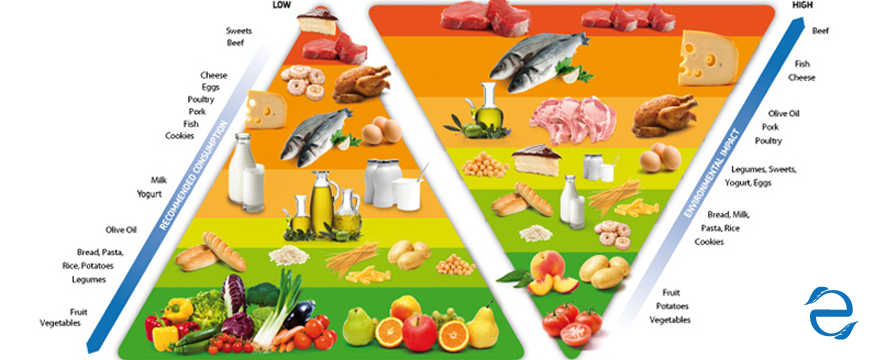
What is the environmental impact resulting from production, distribution, and consumption of food? To answer these questions, the Barilla Center for Food & Nutrition created the Double Food – Environmental Pyramid model, a tool that compares the nutritional aspect of foods with their environmental impact.
A unique food model created to protect the wellbeing of people and the environment
The environmental pyramid was created by studying and measuring the impact of foods already present in traditional food pyramids on the environment, and placing them along an upside down pyramid, where foods placed at the lowest level (at the peak of the triangle) have the lowest environmental impact. Placing the two pyramids next to each other, the “Double Food-Environmental Pyramid” allows people to see seen that the foods that area advised to be eaten more, are also, generally, those that have the lowest environmental impacts. On the other hand, foods that are advised to be eaten less are also those that have a greater environmental impact.
The Double Pyramid for growing children
For the construction of the Double Pyramid “for those who are growing”, the same approach was employed as the one used to achieve the “adult” version by placing alongside the usual environmental pyramids, the food ones that had been made by taking into account the nutritional needs of children and adolescents. When considering children, or more generally, people who are still growing (up to 20 years of age), certain foods take on a different importance. The guidelines of the USDA – United States Department of Agriculture (one of the references considered), suggest a different distribution of sources of protein – especially meat – than that of adults, without affecting the mode of reading the double pyramid: foods with the lowest environmental impact are the ones most recommended for consumption.
Summary of macro-guidelines for healthy growth
Adopt a healthy and balanced diet that daily alternates all the main foods that supply all the nutrients and micro-nutrients (calcium, iron, vitamins, etc.) that children and adolescents need.
Avoid excessive intake of calories by consuming high-calorie or high-fat foods.
Divide up the intake of nutrients during the day in a balanced way, ensuring that there is a balance between animal and vegetable proteins, simple and complex sugars (by eating less sweets and more bread, potatoes, pasta or rice), vegetable and animal fats (using less lard and butter and more olive oil).
Reduce the intake of salt to a minimum in order to reduce additional risk factors for developing hypertension, especially in adulthood.
Distribute food intake over five times in the day: breakfast, morning snack, lunch, snack and dinner.
Avoid eating food outside the five times previously identified.
Engage in physical activity for at least an hour a day, including that of both sports and just playing.
Minimize a sedentary lifestyle as much as possible, particularly the time spent in front of a video screen (television and computers).
With energy efficiency on everyone’s mind in the last few years, experts are looking into ways to make the general food chain more ecologically conscious as well.
![How Urbanization affects the Environment [Infographic] | ecogreenlove](https://ecogreenlove.com/wp-content/uploads/2015/04/042715_urbanizationeffects.png?w=888&h=360&crop=1)
![How Urbanization affects the Environment [Infographic] | ecogreenlove](http://www.gotchawildlife.com/wp-content/uploads/2015/03/How-Urbanization-Affects-the-Environment.jpg "How Urbanization affects the Environment [Infographic] | ecogreenlove")
![The Meatless Monday Phenomenon [Infographic] | ecogreenlove](https://ecogreenlove.com/wp-content/uploads/2015/04/042015_meatlessmonday.png?w=888&h=360&crop=1)



 ecogreenlove