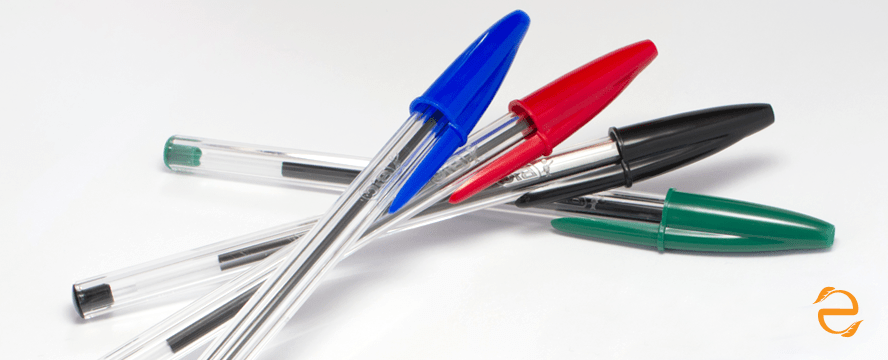
Reusing old Pens

What do you do when you’ve finished with a used ink pen – toss it in the trash? Probably, because that’s what we all do. It’s about the only thing you can do with an old pen.

“According to the EPA, Americans throw away 1.6 billion disposable pens every year. Add the rest of the world, multiply by over 50 years of writing with disposable pens, and that’s a lot of metal and plastic waste ending up in landfill!  I suspect it’s just the tip of the iceberg, given the piles of disposable pens that many of us haven’t thrown out yet. Not to mention the refillable pens that we never take the trouble to refill. (…)

Fast forward to the age of Bic, and the advent of cheap, disposable pens. New habits were formed, and ballpoint pens (not refills) were soon sold by the pack. Now, everywhere we turn, someone is handing us an inexpensive pen with their company name on it. Many end up in a drawer, pencil cup or purse, never to see the light of day or fulfil their intended function. Others are pitched in the trash when they run dry.” As written by Fredrica Rudell on We Hate to Waste

Complete pens can’t go into normal plastic recycling bins because they contain bits of metal, as well as the remainder of the ink. The barrels themselves are typically “Type 5 recyclable plastic,” according to Pilot, but all metal components and the refills have to be removed before recycling. So, even if you disassembled every pen you use, you would still be left with a pile of clips, plungers, springs, barrel rings, screw-on tips, and refills.

There are a few choices:

Continue reading “Reusing old Pens”

Image

Winter Storage: Keeping Your Harvest All Year Round [Infographic]

Written by Abby Quillen, Published on Fix.com

Our ancestors built root cellars, underground structures that kept food at a consistently cold temperature year round. Depending on individual needs, it may be worth building a root cellar or another type of food storage system if you don’t have ideal conditions to store winter crops. But before you start digging or building, it’s important to assess whether the chosen dwelling – probably a garage, shed, basement, cellar, or unheated room – already provides the ideal conditions for storing some food.

Continue reading “Winter Storage: Keeping Your Harvest All Year Round [Infographic]”

How many wears before you need to wash your clothes

060215_wash-guide

We all wash our clothes to keep ourselves and our clothes smelling so fresh and oh-so-clean, but there is such a thing as too much washing and too little. There are downsides to both extremes: laundering your clothes more than you need to can shorten their lifespan and wear them out quickly, but washing too rarely can be unhygienic and cause a lot of icky bacteria growth. Here’s a general guide to follow:

Continue reading “How many wears before you need to wash your clothes”

Image

DIY Greenhouse [Infographic]

DIY Greenhouse [Infographic] | ecogreenlove

DIY Greenhouse [Infographic] | ecogreenloveBrought to you by Custom Made

A home garden greenhouse may seem like a daunting item on a gardener’s wish list. It comes in the form of a pipe dream or is shuffled into the “one of these days” category.

Greenhouse dreams typically resurface when coming home from a weekend adventure to find freshly emerged seedlings on their deathbeds. Sometimes they can be coaxed back to life and other times they are beyond revival, but these young phyto-children could have been saved with a simple DIY greenhouse.

A greenhouse provides plants with a head start by sheltering them from whatever the weather is up to outside. Greenhouse gardeners can sow seeds weeks before the topsoil is warm enough for outdoor germination. And late-season producers can keep fruiting beyond their outdoor counterparts. With a temperature-controlled environment, a wider variety of species, which would otherwise be intolerant of the climate on site, are available. In addition to supreme growing conditions, herbivory and parasites are less of an issue in a greenhouse, since neighborhood deer or a swarm of locusts can’t get to the protected plants.

Continue reading “DIY Greenhouse [Infographic]”

Image

Savvy Salvagers Pallet Projects [Infographic]

Brought to you by Crowes Sawmills

Over two billion pallets are used every day to move stuff about, but the humble little transporter is way more versatile than just that. Creative minds have used pallets to make everything from doggie beds to dressing screens. This savvy salvagers infographic gives you tons of ideas for using pallets in your own home and guides you through the process, from picking safe pallets to gathering your tools, so that you can make your own pallet furniture for your own home. Don’t forget to share all your brilliant creations.