I love flea markets, I love second hand shops. If I can find something I like, or something I think it would be useful or “pretty” but is cheaper than if I would buy it on a store… I really wouldn’t mind if it was already used, as long as is still functional. I support this market because I think is part of an “eco-lifestyle”. What would be the point of upcycling and reusing if I’m buying more and more stuff from the big companies/stores? To me, I’m supporting the local business but also I’m avoiding the big consumerism. “Somebody’s trash, may be somebody’s treasure”. And if that comes with the “plus” of helping some charity cause, even better!
Is stress bogging you down? Yeah, it happens to the best of us. Managing stress can feel easier said than done – but that doesn’t have to mean losing sleep over it. We’ve got five handy tips to help ease your anxiety. The short story?
In the Gardening paradise… choosing some veggies to grow
Some flowers… this year I want to try to grow sunflowers and, why not, edible flowers?
So all in all, this is what we’ve got!
Reusing egg cartons as seed starters
beginning with 50 seeds… for now, these are only the ones that can be sow until March
And after 1 week… Salad is sprouting. This is exciting!
Stretching out!
Getting some sun!
A handful of lettuce growing
So March arrived, and with it the excitement of starting sowing once again. Last year was my very first year to (seriously) grow something, and in the autumn of 2013 we harvested a good bunch of bell peppers, red chillies, lettuce and cocktail tomatoes. This time, ecogreenlove is going for more! Trying other seeds, seeds from sachets that we’ve bought but also trying to sow from last year’s harvest… we’ll see how it all goes.
Also, this year we started Bokashi composting, which means, we don’t need to buy fertilizer, we are practically making our own soil directly from our kitchen, 100% organic (and the big advantage is that I can be sure it is 100% organic, not only because the label says so). Another difference is that we are planting more and different vegetables rather than flowers.
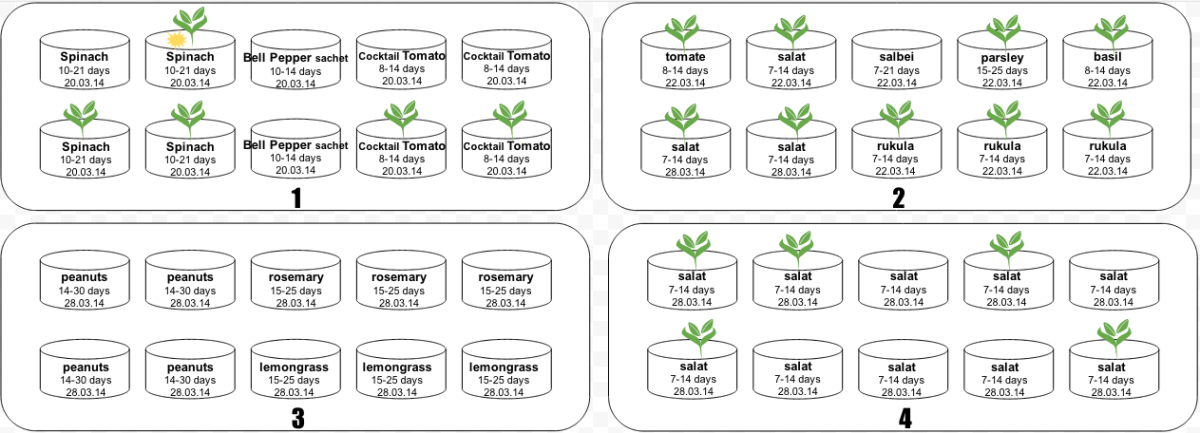
And something I learned is that you really have to be organized when sowing. So many times I tried to plant something and never grew or eventually died, so we’re giving the seeds a better look and care this time, and I’m creating a timetable of when we’re planting what, when is sprouting and when we’ll be transplanting, as well as ideal conditions (temperature, soil, etc)
I even draw a very basic graphic to know which seeds are in which egg cartons, because as you can see, we planted most of them reusing egg cartons. So here is an example:
So far, we only have 50 seeds growing because of our small space, we do not have a garden, what we are doing is planting in our balconies, so everything has to be very well distributed having each the space they need. So there will be an update for this post when we manage to sow the rest of our vegetables and herbs. The weather here in southwest Germany is still fresh and rainy, so we are starting the seeds indoors. Now, since we didn’t plant aaaaall the seeds, I want to save some for next year (from harvest and from sachets), I did some research and here are some tips if you are also planning to do that:
Learn how to avoid these common mistakes for success every time.
Story by Ann Taylor Pittman, Tim Cebula, and Cooking Light Staff
You can learn from your mistakes, but it may result in ugly cakes, calorie overloads, and even singed arm hair (ouch!). Learn from our cooking, nutrition, grilling, and baking mistakes instead! Every cook, being human, errs, bungles, botches, and screws up in the kitchen once in a while. If you have not “caramelized” fruit in salt rather than sugar, you have not suffered the most embarrassing mistake made by one of our editors. We did not have to look much farther than our staff―and their encounters with readers, friends, and relatives―to compile a list of common, avoidable culinary boo-boos.
The creative cook can often cook her way out of a kitchen error, but the smart cook aims to prevent such creativity from being necessary. Here are over 50 ways to be smarter every time.
1. You don’t taste as you go.
Photo: Oxmoor House
Result: The flavors or textures of an otherwise excellent dish are out of balance or unappealing.
For most cooks, tasting is automatic, but when it’s not, the price can be high. Recipes don’t always call for the “right” amount of seasoning, cooking times are estimates, and results vary depending on your ingredients, your stove, altitude…and a million other factors. Your palate is the control factor.
Think that experienced cooks don’t forget this most basic rule? Cooking Light Associate Food Editor Tim Cebula was sous chef in a notable restaurant when he served up “caramelized” pineapple that somehow refused to brown. Turns out Tim had coated the fruit in salt, not sugar. “That’s why it wouldn’t caramelize.”
2. You don’t read the entire recipe before you start cooking.
Photo: Oxmoor House
Result: Flavors are dull, entire steps or ingredients get left out.
Even the best-written recipes may not include all the headline information at the top. A wise cook approaches each recipe with a critical eye and reads the recipe well before it’s time to cook. Follow the pros’ habit of gathering your mise en place―that is, having all the ingredients gathered, prepped, and ready to go before you turn on the heat.
“Trust me,” says former Cooking Light Test Kitchen tester Mary Drennen Ankar, “you don’t want to be an hour away from dinner guests arriving when you get to the part of the recipe that says to marinate the brisket overnight or simmer for two hours.”
3. You make unwise substitutions in baking.
Photo: Romulo Yanes & Randy Mayor
Result: You wreck the underlying chemistry of the dish.
Substitutions are a particular temptation, and challenge, with healthy cooking. At Cooking Light it’s our job to substitute lower-fat ingredients―to change the cooking chemistry a bit while capturing the soul of a dish. When it comes to baking, this is as much science as art.
“I’ll get calls from readers about cakes turning out too dense or too gummy,” says Test Kitchen Director Vanessa Pruett. “After a little interrogation, I’ll get to the truth―that the reader used ALL applesauce instead of a mix of applesauce and oil or butter or went with sugar substitute in place of sugar.” Best practice: Follow the recipe, period.








 ecogreenlove