
There’s no shortage of bad news in the media to “doomscroll”, but research suggests the compulsive urge to surf the web can lead to poor mental and physical health outcomes. Doomscrolling is the tendency to “continue to surf or scroll through bad news, even though that news is saddening, disheartening or depressing”, a practice researchers found has boomed since the onset of the pandemic. 1
Taking conscious steps to limit our news consumption might help and be beneficial for the wellbeing. Here are some good tips we found around.
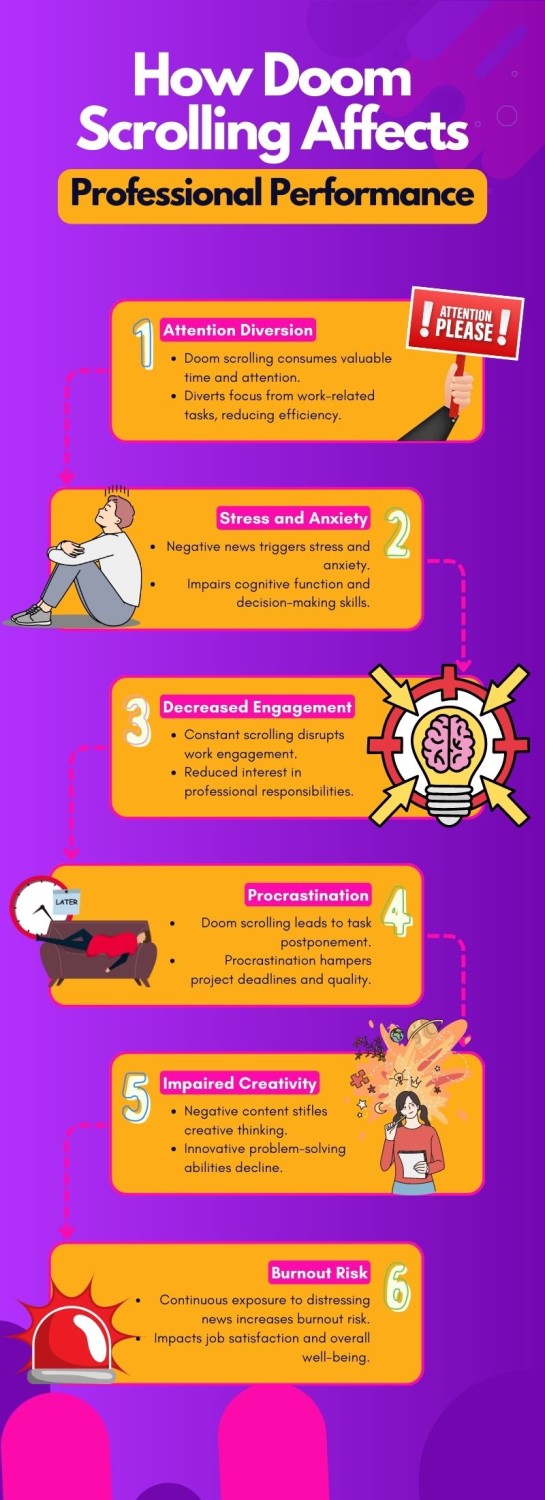
How Doom Scrolling Affects Our Professional Productivity
Doom scrolling might seem harmless, but it significantly impacts work and learning:
- Time waste: Brief checks turn into hours, stealing from productive tasks and learning.
- Attention diversion: Constant scrolling disrupts focus, hampering efficiency and quality.
- Memory impairment: Negative news triggers stress hormones, hindering information processing and retention.
- Motivation drop: Endless negativity breeds hopelessness, sapping motivation and growth.
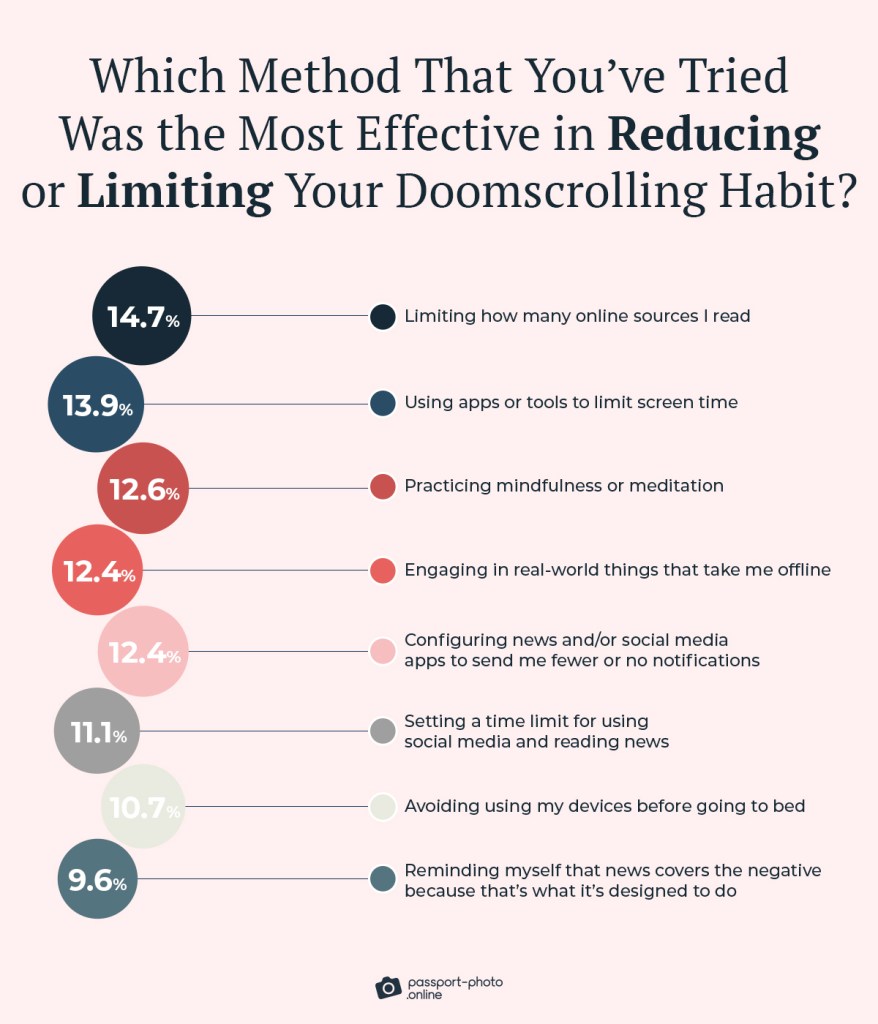
Reflect on your news consumption
Yes, it’s important to stay up to date and know what’s happening in the world, but you don’t have to follow developments 24/7.
There’s no magic formula, but a good way to start is to:
- Avoid turning on every device in the house the moment you get out of bed.
- Try to reflect on how much news you consume and when it’s appropriate to do it.
- Choose trustworthy sources, background stories and fewer clickbait headlines.
- Set yourself a time and duration for reading news, such as 20-30 minutes in an afternoon.
- And turn off notifications and breaking news alerts. Prefer to read a daily summary instead. 3
Break the cycle
Breaking the vicious cycle starts with recognizing the social media envy or doomscroll spiral as it takes hold. With some habit breaking, the spiral doesn’t need to happen at all.

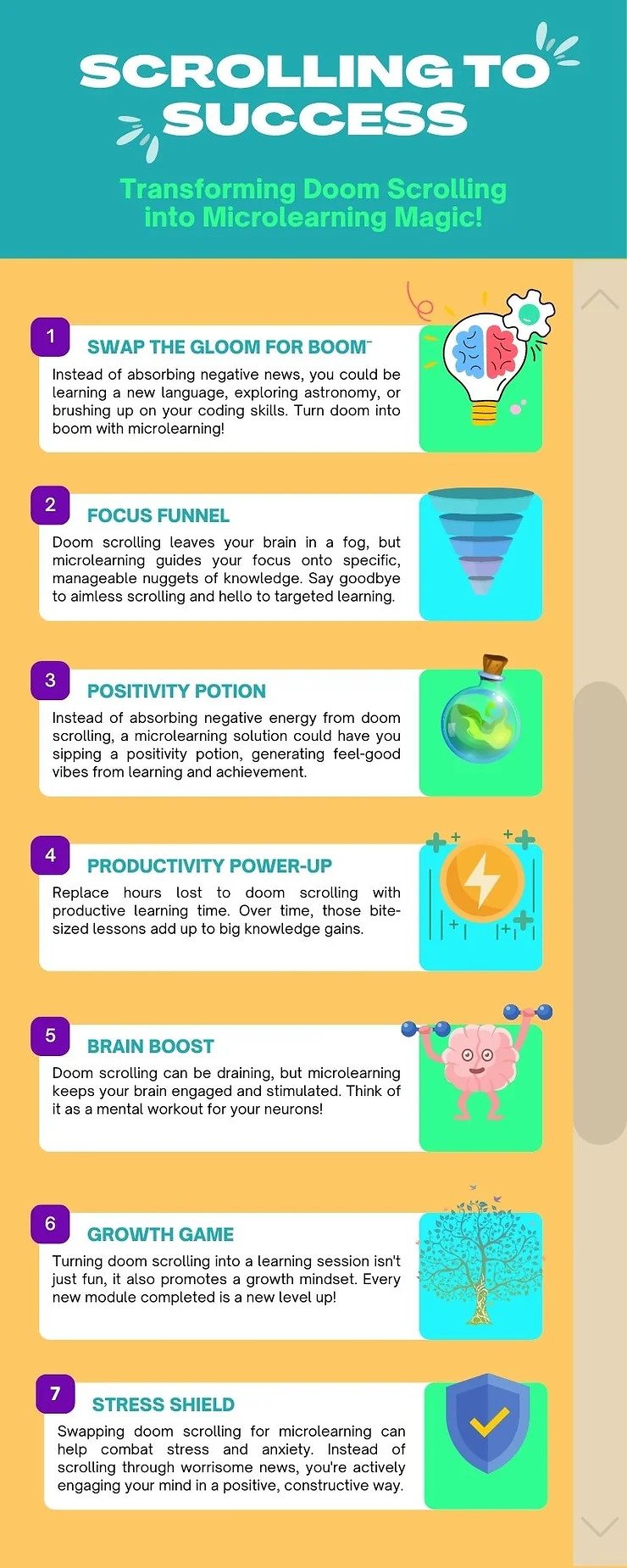
Microlearning as Solution to Combat Doom Scrolling
Microlearning, as the term suggests, refers to a pedagogical approach that breaks down information into bite-sized, focused units for learning. It’s a modern educational paradigm that embraces the idea of simplicity and brevity, aligning learning with our brain’s natural propensity for absorption in short, concentrated periods. Typically, a single microlearning module lasts from 3 to 5 minutes, but the content is rich and targeted, allowing learners to acquire specific knowledge or skills in a brief span.
The benefits of a microlearning solution are manifold and include the following:
- Reduces cognitive overload: By presenting information in manageable pieces, it promotes better understanding and retention of knowledge.
- Accommodates short attention spans: Microlearning fits into busy schedules, allowing people to learn on-the-go or during breaks.
- Fosters a sense of accomplishment: As learners can swiftly complete modules, their motivation to continue learning is bolstered.
- Is Adaptable: A microlearning solution can easily be updated or modified to remain relevant and current.
4 Apps to Break the Cycle through Microlearning
- Blinkist
Blinkist is a popular microlearning app that provides key insights from non-fiction books in bite-sized formats. It offers summaries, called “Blinks,” which you can read or listen to in just a few minutes. - Duolingo
Duolingo is a language-learning app that utilizes microlearning techniques to teach you new languages in short, interactive lessons. Duolingo’s gamified approach keeps the learning process engaging and addictive. - Audible
Audible offers a vast collection of audiobooks, podcasts, and original audio content covering a wide range of subjects. Audible also offers a variety of short or micro listens, perfect for those seeking quick bursts of inspiration or learning in busy lives. - Calm
Calm is a popular mobile app for relaxation, mindfulness, and better sleep. It offers various features and guided exercises to manage stress, anxiety, and improve mental well-being. The app provides a wide range of guided meditations, from short sessions to longer programs, to suit different preferences and time constraints.
Sources:
1 Doomscrolling linked to poor physical and mental health, study finds | The Guardian, Sep 2022
2 The Danger of Doom Scrolling & How Custom e-Learning Solutions Can Help | Thinkdom, Aug 2023
3 Doomscrolling: What bad news does to us | Deutsche Welle, Oct 2023
4 How to Stop Doomscrolling for the sake of your Mental Health! | The Happy Broadcast, Aug 2023
5 Microlearning Solution: A Positive Break from Doom Scrolling | Thinkdom, Jun 2023
6 The Doomscrolling Pandemic [2023 Study] | Max Woolf, Jul 2023
![Digital Minimalism: Habits & Tips to Declutter Your Devices [Infographic]](https://ecogreenlove.com/wp-content/uploads/2022/10/10122022_digitalminimalism.jpg?w=1200)
![How Digital Hoarding impacts our Health and the Environment [Infographic]](https://ecogreenlove.com/wp-content/uploads/2021/04/04262021_digitalclutter.jpg?w=1200)
![The carbon footprint of the digital age [Infographic]](https://ecogreenlove.com/wp-content/uploads/2016/08/08152016_digitalcarbonf.png?w=888)


Join the ecogreenlove community
Tags: Doomscrolling, Health, News, Digital Health, Mental Health

 ecogreenlove