
![Earth Overshoot Day [Visuals] | ecogreenlove](https://ecogreenlove.com/wp-content/uploads/2023/08/08022023_earthovershoot.jpg?w=1024)
Earth Overshoot Day marks the date when humanity’s demand for ecological resources and services in a given year exceeds what Earth can regenerate in that year.
It is hosted and calculated by Global Footprint Network, an international research organization that provides decision-makers with a menu of tools to help the human economy operate within Earth’s ecological limits.
Earth Overshoot Day 2023 falls on August 2*.


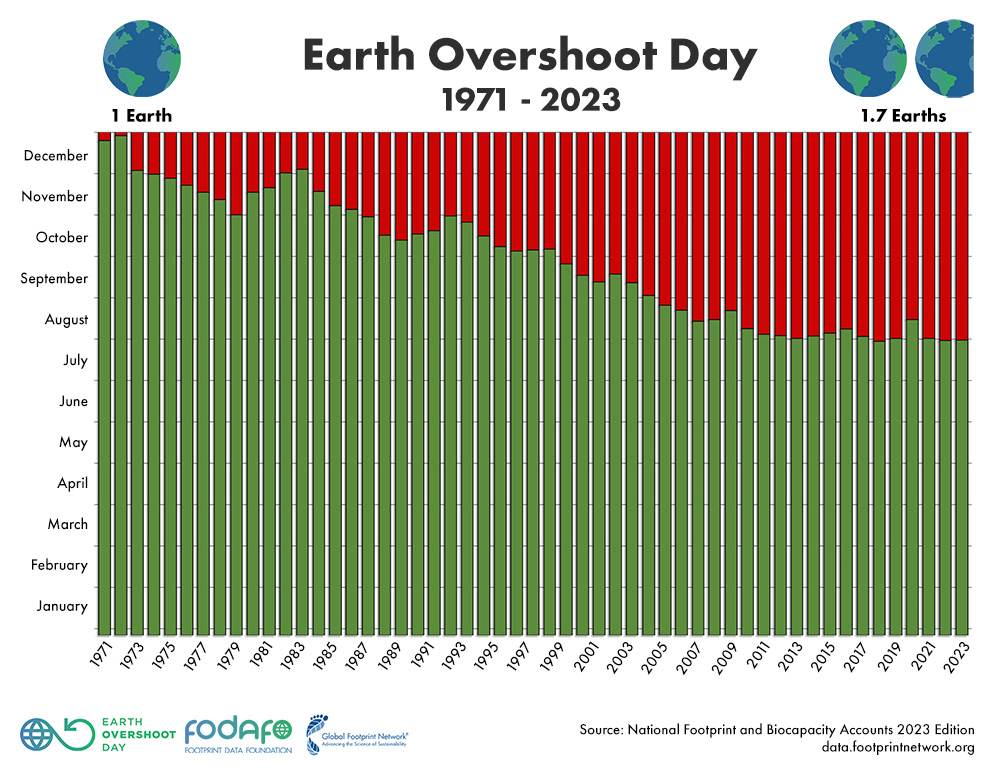
The current trend is not our destiny
#MoveTheDate Solutions:
The past does not necessarily determine our future. Our current choices do.
While our planet is finite, human possibilities are not. The transformation to a sustainable, carbon-neutral world will succeed if we apply humanity’s greatest strengths: foresight, innovation, and care for each other.
There are five key areas identified that are defining our long-term trends most forcefully, all of which are shaped by our individual and collective choices. We can #MoveTheDate embracing these kinds of solutions:

- Planet: How we help nature thrive
Reforesting 350 million hectares of forest would move the date of Overshoot Day by 8 days. - Cities: How we design and manage cities
If we reduce our Footprint from driving by 50% around the world and assume one-third of car miles are replaced by public transportation and the rest by biking and walking, Earth Overshoot Day would move back 13 days. - Energy: How we power ourselves
Reducing the carbon component of humanity’s Ecological Footprint by 50% would move Earth Overshoot Day by 93 days, or more than three months.
Existing off-the-shelf, commercial energy-efficiency technologies for buildings, industrial processes, and electricity production could move Overshoot Day at least 21 days, without any loss in productivity or comfort. - Food: How we feed ourselves
If we reduced global meat consumption by 50% and replaced these calories through a vegetarian diet, we would move Overshoot Day 17 days (including 10 days from reduction of methane emissions).
If we cut food waste in half worldwide, we would move Overshoot Day 13 days. - Population: How many of us there are
If every other family had one less child and parenthood was postponed by two years, by 2050 we would move Overshoot Day 49 days.*
*NOTE: If we continued as now, we would be at 9.7 billion. This is the UN medium variant estimate. If each mother or father had on average 1.8 children (= 0.9 children per person), compared to 2.3 currently, and parenthood was delayed by 2 years, we’d be at 7.7 billion in 2050. You can play with other assumptions using this downloadable cohort model. Assuming humanity’s Ecological Footprint per capita stays at 2020 levels (2.47 gha per person), the difference in 2050 would be 49 days.
There is immense #PowerOfPossibility in the countless existing solutions that #MoveTheDate. With them, we can make ourselves more resilient and #MoveTheDate of Earth #OvershootDay.
*Learn more about how the 2023 date was calculated. Explore and download the data at data.footprintnetwork.org.
Sources:
• Earth Overshoot Day
• Global Footprint Network


Join the ecogreenlove community

 ecogreenlove