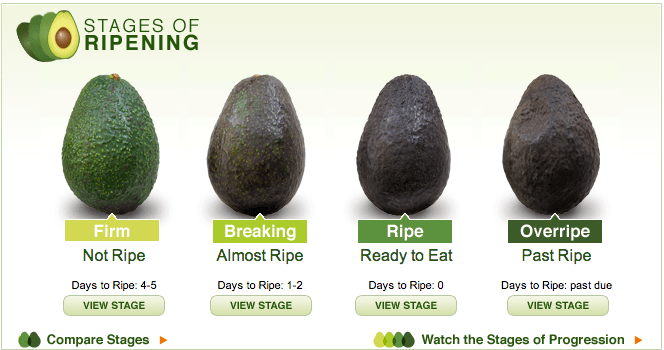
Did you know that Hass Avocados do not ripen on the tree? They ripen or “soften” after they have been harvested. Hass Avocados are unique from some of the other varieties of avocados because they can change from a dark-green color to a deep purplish almost black hue when ripe. Although skin color can help in the initial visual selection of Hass Avocados it is not always the best indicator for ripeness. Ripeness is ultimately determined by pressure, color can sometimes be misleading as avocado “softening” can occur at a varying rate, independent of the color.
How to pick the best Avocados
1. Take a look at the chart below. When comparing a group of Hass Avocados, check the outside color of the skin of the avocados for any that are darker in color than the others. These may be riper than Hass Avocados with lighter skin. Check the outer skin of the avocado for any large indentations as this may be a sign that the fruit has been bruised.
Note: Avocado color does not always indicate ripeness. Ripe avocados will yield to firm gentle pressure
2. Place the avocado in the palm of your hand.
3. Gently squeeze without applying your fingertips as this can cause bruising.
4. Picking ripe ready-to-eat Hass Avocados. If the avocado yields to firm gentle pressure you know it’s ripe and ready-to-eat. If the avocado does not yield to gentle pressure it is considered still “firm” and will be ripe in a couple of days. If the avocado feels mushy or very soft to the touch it may be very ripe to overripe.
Practice makes perfect – if it’s your first time selecting avocados, try choosing a couple of avocados that yield to gentle pressure to see how they differ in taste. Or try purchasing an unripe avocado, checking it every day for 2 – 3 days as it softens. Practice will help you learn what to look for when you’re in the store.
How to Store Unripe Avocados
Unripe, firm or green fruit can take four to five days to ripen at room temperature (approximately 65-75 degrees F, avoid direct sunlight). Refrigeration can slow the ripening process, so for best results store unripe fruit at room temperature unless room conditions exceed that range.
Store Cut Unripe Avocados – If you have cut open your Hass Avocado and found it to be unripe, sprinkle the exposed flesh of the avocado with lemon or lime juice, place the two halves back together and cover tightly with clear plastic wrap before placing in the refrigerator. Check the avocado periodically to see if it has softened up enough to eat. Depending on firmness when the fruit was cut and temperature conditions, the ripening process will vary.
How to Store Ripe Avocados
Ripe fruit that has not been cut open can be stored in the refrigerator for two to three days.
Store Cut Ripe Avocados – Sprinkle cut, mashed or sliced fruit with lemon or lime juice or another acidic agent and place in an air-tight container or tightly covered clear plastic wrap. The fruit can be stored in your refrigerator for a day.
Store Guacamole – Guacamole often contains other ingredients that may affect how well and how long the guacamole can be stored. For most guacamole recipes, adding an acidic agent (like those in the right column) can help prevent oxidization when added on top of the guacamole. To store guacamole, place it in an air-tight container and press clear plastic wrap on the surface of the guacamole before covering to help prevent oxidation. Store in the refrigerator.
If refrigerated guacamole or fruit turns brown during storage, discard the top oxidized layer and enjoy the rest.
How to Ripen or Speed up the Ripening Process for Avocados
Avocados do not ripen on the tree, they ripen or “soften” after they have been harvested. To speed up the avocado ripening process we recommend placing unripe avocados in a brown paper bag with an apple or banana for two to three days until they are ripe. We do not recommend any other method of ripening.
Why does this work?
The plant hormone ethylene, which occurs naturally in fruits like apples and bananas, triggers the ripening process. When combined in a brown paper bag, which helps to trap the ethylene gases produced by these fruits, these gases can cause the fruits to ripen faster together.
How to Freeze Avocados
Did you know avocados can be frozen? Though Fresh Hass Avocados are preferred for their taste and versatility, with the proper preparation, pureed avocados can be frozen and used in guacamole dips, dressings and spread on sandwiches.
Whole, cut, diced or mashed avocados do not have as desirable of a result when frozen. Guacamole can often contain other ingredients that do not freeze well so we do not recommend freezing guacamole.
Follow the instructions below to get the best possible result when freezing pureed Hass Avocados.
1. Wash – Wash the outside of the avocados thoroughly by holding them under running water or in your selected produce wash.
Find more avocado washing and preparation tips.
2. Cut – Cut and peel the avocados.
3. Puree – Place the peeled avocados in a food processor or blender. Add a ratio of one tablespoon of an acidic agent like lemon or lime juice for each avocado you are freezing. Puree until smooth. This will ensure that the lemon or lime juice is evenly distributed to help to prevent the avocados from turning brown. Mashing the avocado rather than pureeing yields a less desirable result because the acidic agent is unevenly mixed in.
4. Package – Place the pureed avocado into an air-tight container. Leave ½ to 1 inch of headspace in the container to allow for expansion. Close your container tightly and label accordingly. Freeze.
Frozen avocado puree must be used within four to five months of freezing.
So this is how I wash, dry and store my lettuce so that it is fresh and ready for salad whenever I need it! I use this method for all types of lettuce (except iceberg, see the end of this post for information about cleaning and storing iceberg lettuce) and it also works for other types of greens and hearty herbs such as parsley.
1. Fill a sink* with cold water, separate all the leaves of lettuce, place them in the water and swirl them around. If the lettuce is a bit limp, let it soak in the water for 30 minutes and it will miraculously come back to life.
2. Drain the water, turn on the faucet, and briefly rinse* each piece of lettuce as you remove it from sink and place in the basket of your salad spinner. If you use organic lettuce, just give each piece a quick once-over to check for clinging bugs and dirt. As you put the lettuce in the spinner, you can tear the leaves in half if they are large (such as full-size romaine).
3. When the spinner is full but not tightly packed, spin the lettuce until dry.
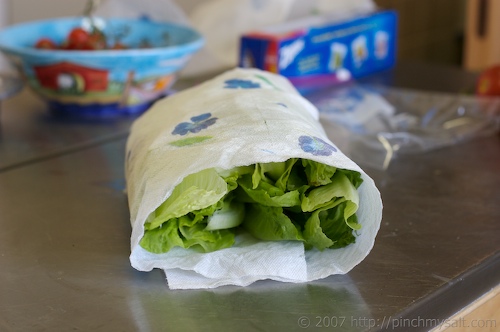
4. Spread two paper towels (still connected) on the counter and pile the dry lettuce in the middle. Wrap the paper towels around the lettuce and slide into a gallon-size zippered plastic bag. Squeeze the air out and close the bag.
5. The lettuce can now be stored in the fridge and should stay fresh for at least a couple of weeks. You can take out what you need whenever you want to make a salad or sandwich and then just reseal the bag. The plastic bags can also be reused!
*My advice would be: instead of filling the sink with cold water and then draining it afterwards, why not filling a big bowl and then reuse it watering the plants, and when is time to rinse each leaf directly with the water running from the faucet, let the water run into the bowl (the same or another) in order to not wasting water and reusing it for something else, as I said, watering the plants may be a good option.
Find the full original article here, gives a lot of other tips including salad additions and dressings, totally worth it.

Though Fresh Hass Avocados are preferred for their taste and versatility, with the proper preparation, pureed avocados can be frozen and used in guacamole dips, dressings and spread on sandwiches.



 ecogreenlove